
Rubik's Cube: A Timeless Puzzle
Discover the fascinating journey of the Rubik's Cube, from its invention to becoming a global phenomenon. Join us as we celebrate the magic and enduring legacy of this iconic puzzle.
Explore More
Introduction: Rubik's Cube
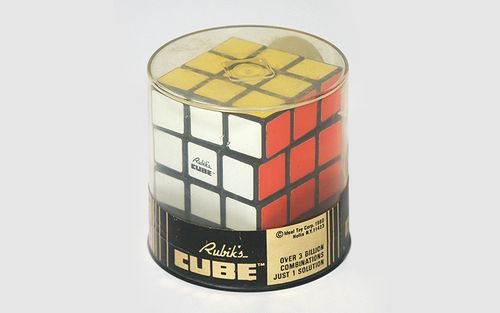
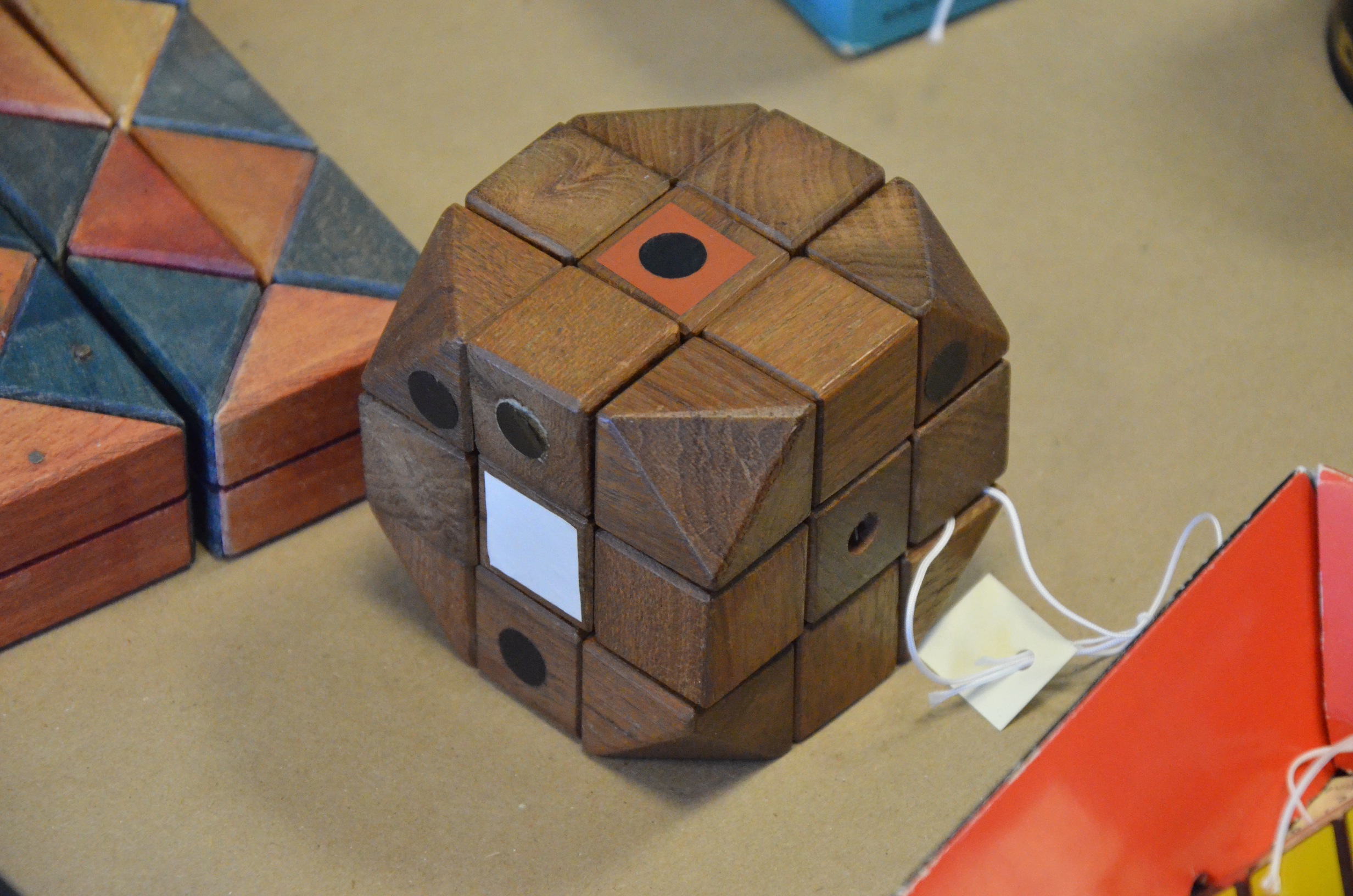
Hungarian design teacher and serious puzzler Erno Rubik assembled his first cube puzzle in 1974 and called it the Magic Cube. After a toy agent pitched the puzzle to Ideal Toy & Novelty Company, it renamed the puzzle Rubik’s Cube and began putting it in stores in 1980. Soon puzzlers all over the world wanted to solve the cube. Within two years they bought one hundred million of them, making Rubik’s Cube the title of most popular puzzle in history. Its success fostered hundreds of spin-off products, from best-selling books on how to solve it to patent-infringing look-alikes by other manufacturers.
Though media first circulated a story about Rubik designing the cube to help teach students about three-dimensional objects, Rubik himself later acknowledged that he purposefully set out to design a puzzle based on geometry. The 27 tiny cubes called “cubies” produced a truly challenging puzzle. Each carried one of six colors, and when assembled they formed a square. Rubik’s challenge was figuring a way to allow the cubies to slide and rotate alongside one another while holding together as a unit. His key insight lay in realizing that if the individual blocks hinged on a rounded core, they could move freely while maintaining the shape of a cube.
Young puzzlers, known as “cubers,” are attracted to the seeming simplicity of the puzzle, and are often skilled at spotting the patterns—cubers call them algorithms—necessary to solve the cube. Since 2003, cube-solving speed records, held by “speedcubers,” have been governed by the World Cube Association. Devoted to fairness and fun, the Association maintains records for blindfolded, one-handed, and fewest moves to solve, among others.
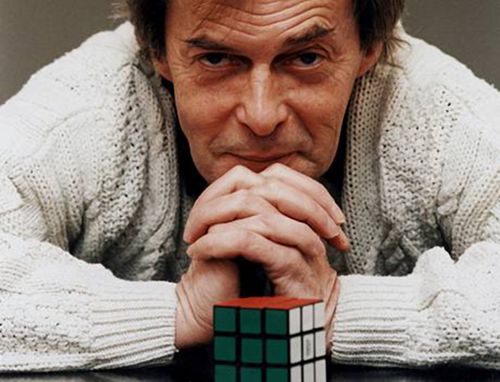
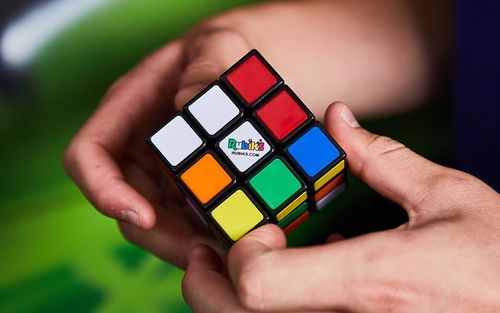
"Like after a nice walk when you have seen many lovely sights you decide to go home, after a while I decided it was time to go home, let us put the cubes back in order. And it was at that moment that I came face to face with the Big Challenge: What is the way home?"
"I was searching for a way to demonstrate 3D movement to my students and one day found myself staring into the River Danube, looking at how the water moved around the pebbles. This became the inspiration for the cube's twisting mechanism. The fact that it can do this without falling apart is part of its magic."
"When you are studying from a book, lots of people go straight to the end to look for the answers. But that's not my style. For me, the most enjoyable part is the puzzle, the process of solving, not the solution itself."
How is it built?
The Rubik's Cube is a marvel of engineering and design, consisting of 26 smaller cubes that form a 3x3x3 structure. Each of these smaller cubes, often referred to as "cubies," is connected to an internal core that allows them to move independently.
The core itself is designed to hold the cubies together while enabling smooth rotation along three axes. The outer surfaces of the cubies are colored, traditionally using six solid colors: white, red, blue, orange, green, and yellow. This color scheme not only aids in solving the puzzle but also adds to its visual appeal. The design ensures that no matter how the cube is twisted and turned, it remains a cohesive unit, ready for the solver's next move.
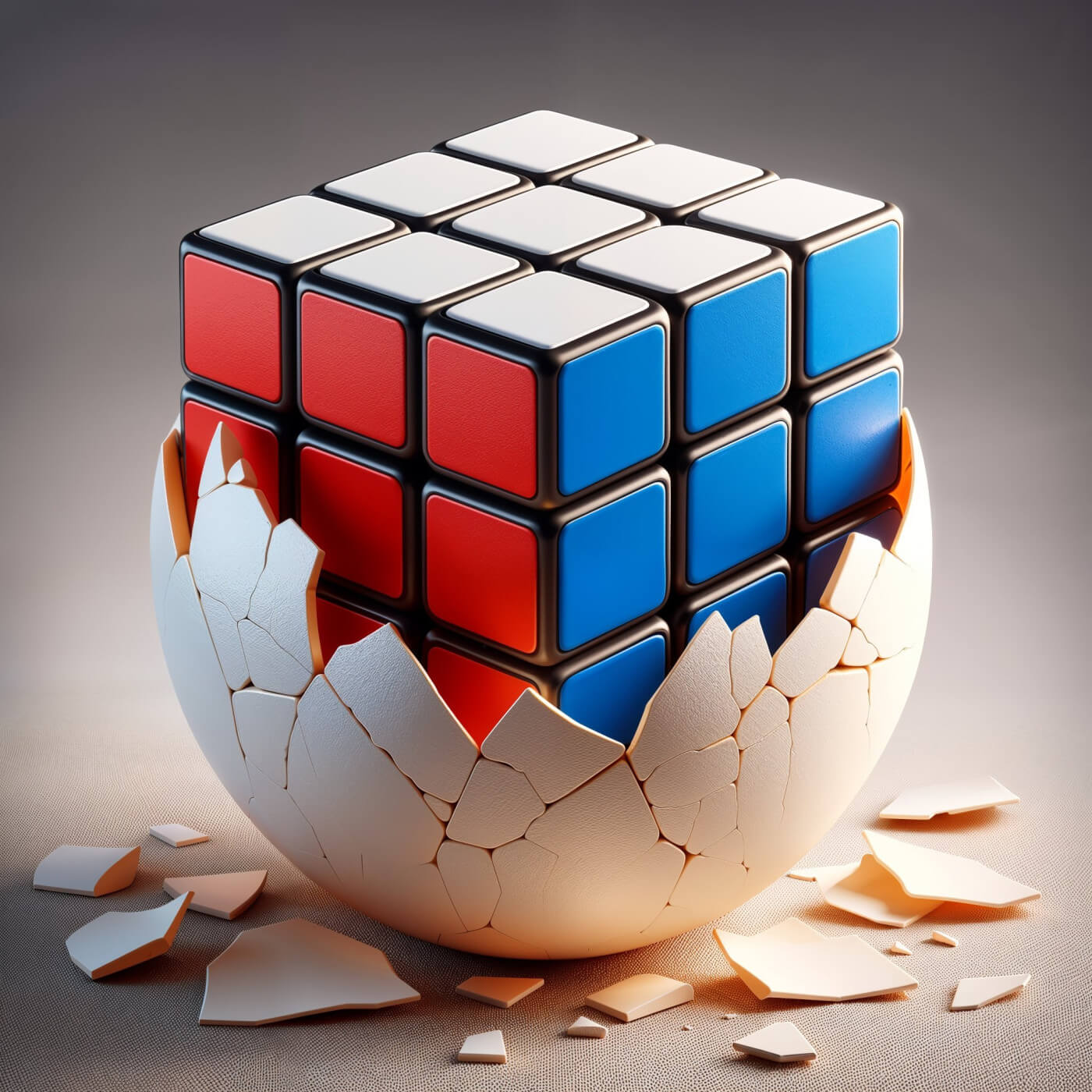
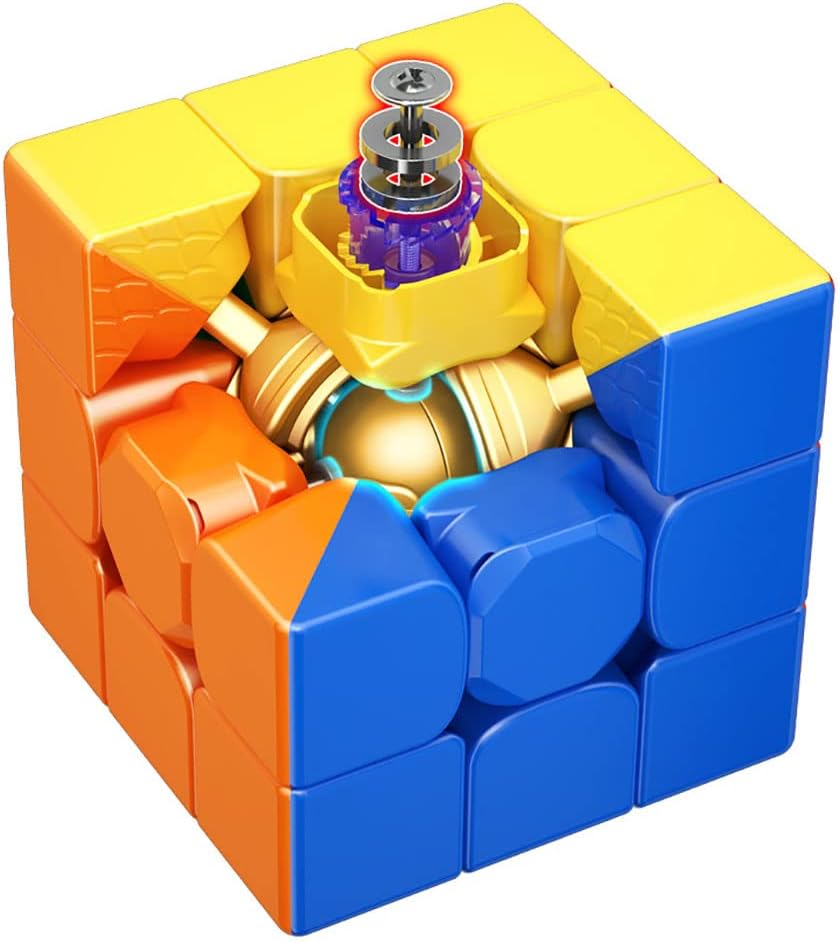
Rubik's Cube: Mechanism
The Rubik's Cube's mechanism is a sophisticated system that allows the puzzle to be both challenging and durable. At the heart of the cube lies a central core with six fixed center pieces, each connected to an internal spindle. This core serves as the anchor for the 20 movable edge and corner pieces, which slide over the core's surface as the cube is manipulated.
The edge pieces, each with two colored stickers, and the corner pieces, each with three colored stickers, are ingeniously designed to fit together without jamming, ensuring smooth and precise rotations. This intricate mechanism is what makes the Rubik's Cube both a tactile delight and a formidable puzzle.
How is it solved?
Solving the Rubik's Cube is both an art and a science, involving a series of algorithmic steps that transform the cube from a jumbled mess into a uniform, color-matched state. Beginners often start with the layer-by-layer method, solving one face and its corresponding edge pieces first, followed by the middle layer edges, and finally the last layer.
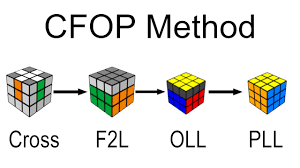
For more advanced cubers, methods like CFOP (Cross, F2L, OLL, PLL) or Roux are employed to achieve faster solving times. These methods break the solving process into smaller, more manageable parts and optimize the number of moves required.
Evolution and Variants
Atari Video Cube
Rubik's Cube also evolved into various forms of electronic game play. In 1982, Atari published Atari Video Cube for the Atari 2600 home console. The game featured a traditional Rubik's Cube, but instead of twisting the various levels, the player moved from square to square, switching each color. Since then, additional electronic Rubik's games have appeared on various consoles, including Rubik's Puzzle World, published for the Nintendo Wii and Nintendo DS in 2008. Game play involves solving the traditional Rubik's Cube puzzle as well as several other mini-game puzzles. PC gamers might enjoy Rubik's Games, published by Hasbro Interactive in 1999. It contains 100 challenges across five different puzzle games, including a standard Rubik's Cube that players can rotate by using a mouse.
Rubik's Revolution & Rubik's Touch
Rubik's Revolution and Rubik's Touch, both handheld electronic games, resemble the classic Rubik's Cube puzzle but provide various twists. Rubik's Revolution is shaped like a traditional cube, but each square includes an LED light. The cube contains six unique games, all of which require the player to follow the lighted patterns across the cube. Its popularity earned it the Toy of the Year Award in 2008. Rubik's Touch plays exactly like a traditional cube, but instead of twisting each level, the player simply slides her finger across the sides of the cube to move the colors around. The cube also provides hints to players who become stuck during the game.
Rubik's Cube in Popular Culture
Despite several decades passing since the invention of the famous puzzle, the Rubik's Cube still remains a staple of 80s culture and is one of the first things that comes to mind when thinking about things from the 80s. The immense popularity of the puzzle has resulted in several appearances throughout the media and the arts, either as a background object or as a key element. Here we will take a look at some of the cube's “appearances” in several different art forms and media.
Rubik's Cube in Film and Television
Rubik's Cubes are used in numerous different ways in film and television series. It could be a device used to help the viewer relate to the character (due to the popularity of the puzzle, it is a fairly reasonable assumption that the majority of the viewer base of an adult film would have grown up with the Rubik's Cube, regardless of the level of influence it had). It could also just be a simple background prop for a scene. However, the majority of uses of the Rubik's Cube within film are to portray the intelligence of a character in a way that everyone can understand. Due to the difficulty of the puzzle for those with no knowledge of the solution, the cube is widely accepted as something that only incredibly intelligent individuals are able to solve. Therefore, the use of the Rubik's Cube within media such as the popular “The Pursuit of Happyness” is more of a theatrical device than simply a vague reference to a memorable object.
Effect on Popular Culture Today
Today there have been over 300 million rubik's cubes sold world wide. This year's speedcubing world championships had over 575 participants from 37 different countries, each of them passing the qualifying time of a 15 second solve on the 3x3x3. Not only do people use rubik's cubes for speedcubing, they also use them as decorative items. Many doctors and CEOs of large corporations have stated that they keep a solved rubik's cube in their office. People of all ages buy the rubik's cube whether they know how to solve it or not. Though the Rubik's cube reached its peak in the 1980s, it still is one of the most popular toys sold today.
1980s Popular Culture
It was not until the 1980s that the rubik's cube reached the western stores. Like before, it immediately became popular because of the simple task with a complicated solution. Its popularity kept growing and soon it was used in film and television. The rubiks cube made an appearance on television shows such as The Fresh Prince of Bel-Air, Seinfeld, Doctor Who, The Simpsons, and Everybody Hates Chris. The media helped its popularity spread faster than before.
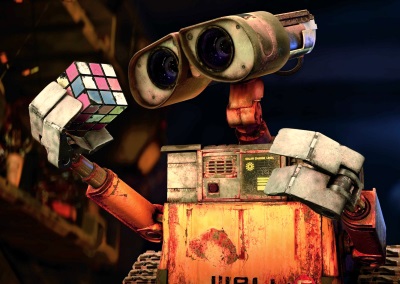
WALL-E
In the popular sci-fi animation WALL-E, the Rubik's Cube is used as an interaction piece between the two main characters, WALL-E and EVE.
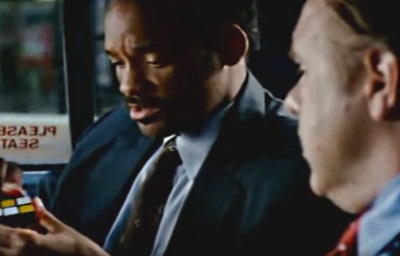
Will Smith in The Pursuit of Happiness
The Pursuit of Happyness, has the cube shown in several different scenes, the most prevalent of which being when Will Smith is explaining to Mr. Twistle how he thinks the cube works.

Better Call Saul (2015 - 2022)
Nacho Varga's girlfriend, Jo seems to be having a bad trip and takes apart everything she finds with scissors to clean them, including a Rubik's Cube.
Speedcubing
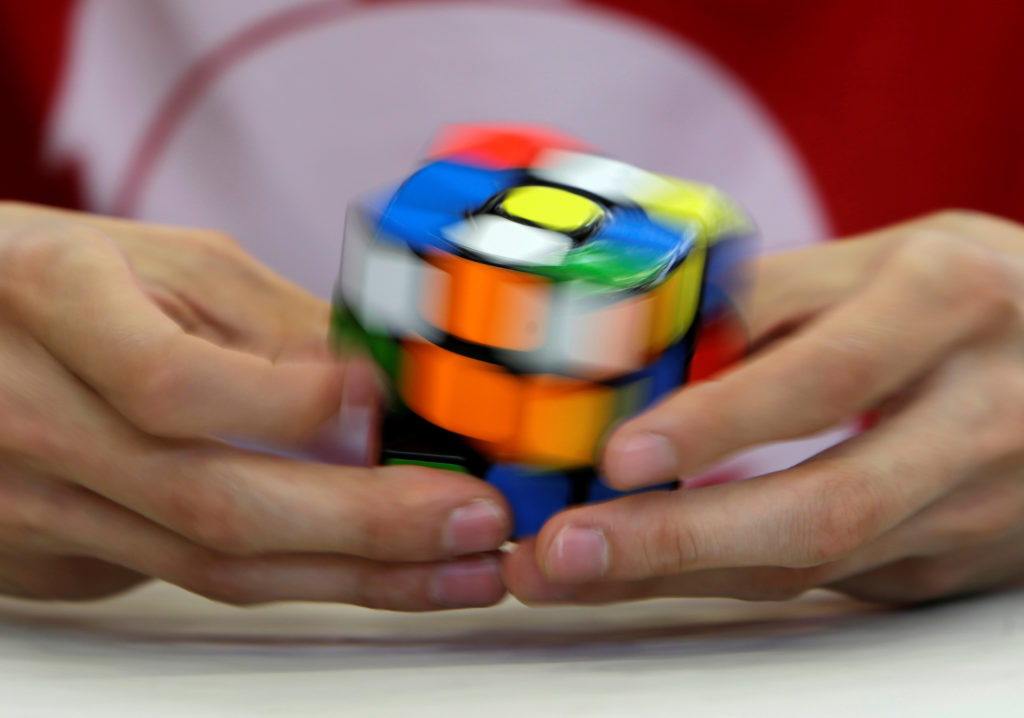
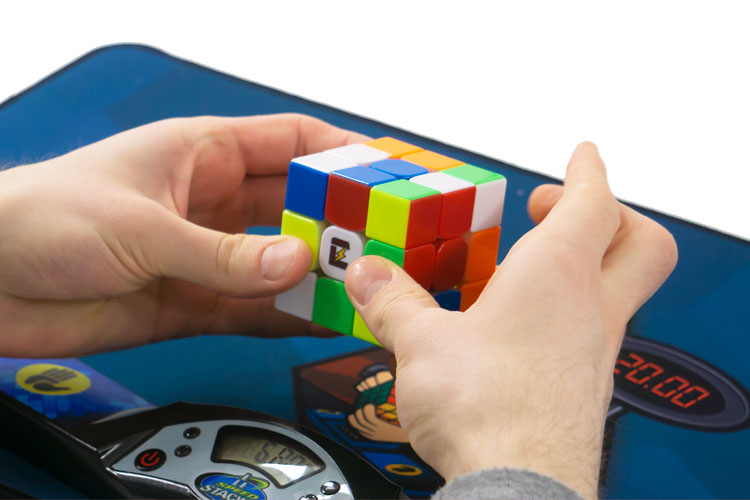
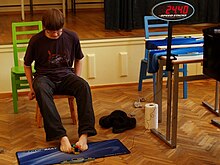
Speedcubing, also referred to as speedsolving, is a competitive sport centered around the rapid solving of various combination puzzles. The most prominent puzzle in this category is the 3x3x3 puzzle, commonly known as the Rubik's Cube. Participants in this sport are known as "speedcubers," who focus specifically on solving these puzzles at high speeds, or more generally as "cubers". The essential aspect of solving these puzzles typically involves executing a series of predefined algorithms in a particular sequence.
World Cube Association (WCA)
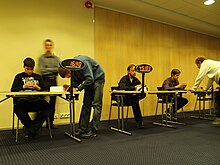
Speedcubing competitions have been held every year since 2003. The World Cube Association (WCA) was formed in 2004 to govern all official competitions. For a competition to be official, it must be approved by the WCA and follow the WCA regulations. Included in the regulations is the necessity of having one or more WCA delegate in attendance. A delegate's main role is to ensure all regulations are followed during the competition. Once the competition is finished, results are uploaded to the WCA website. Judges oversee the round. Delegates help the judge. Runners give the scrambled or solved cube to the competitor. A scrambler scrambles the cube.
Format
The majority of puzzle competitions are held using a trimmed mean of five. This involves the competitor executing five solves in the round in question, after which the fastest and slowest solves are disregarded and the mean of the remaining three is used. The 6×6×6 and 7×7×7 events are ranked by a straight mean of three—only three solves, none of which are disregarded. In 3×3×3 blindfolded and 3×3×3 fewest moves challenges, either a straight mean of 3 or the best of 3 is used, while 4×4×4 blindfolded, 5×5×5 blindfolded, and multiple blindfolded challenges are ranked using the best of 1, 2 or 3, depending on the competition.
Lubrication
Members of the cubing community lubricate their cubes to allow them to be turned faster, easier, smoother, more controllable, and more reliably than a non-lubricated cube. Silicone-based lubricants are commonly used, applied sparingly to the core, springs, screws, and contact surfaces. Regular maintenance, including cleaning and re-lubrication, ensures optimal performance over time.
Fun Facts
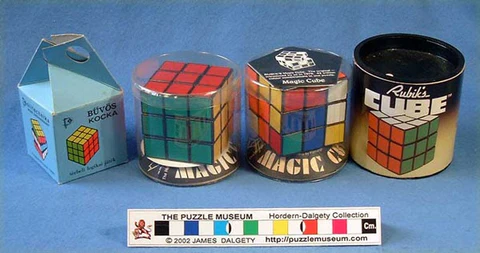
It was initially called the Magic Cube
Back when the Rubik's Cube was first introduced in the market in 1974, it was termed as the 'Magic Cube' or 'Bűvös Kocka' in Hungarian. In order to overcome the international patent challenges that had arisen in Hungary, the Ideal Toy Corporation, which had bought the rights to this puzzle, changed the name to 'Rubik's Cube' in 1980.

Rubik's Cube was a challenge for Ernő Rubik himself
It was never certain that Rubik had managed to find a solution for his invention. It is said that he spent about a month trying to perform different moves to solve this challenge. Once he found a way to solve it, people went frenzy and were motivated to find different ways to solve the Cube.
Speedcubing Competition
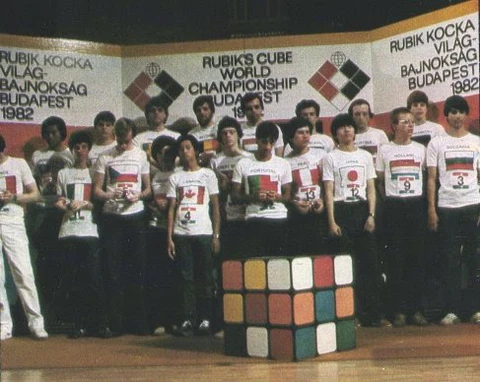
Back in 1982, people began competing in the Cube Solving Events. The first-ever World Championship was hosted in Budapest, and the winner was Minh Thai from the United States, at a speed of 22.95 seconds.
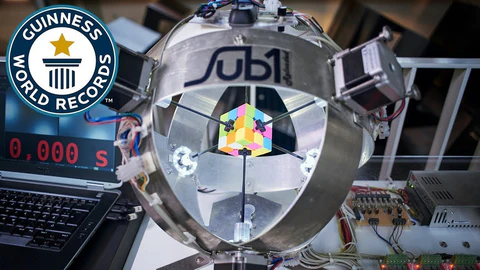
Robots can solve it in under one second
A Robot named Sub1 solved the Rubik's Cube in 0.887 seconds! It used two webcams to capture the arrangement of the sides. It then calculated the solution as the Arduino-compatible microcontroller board applied the 20 Steps. The MultiCuber999 robot received a Guinness World Record for solving 9x9x9 cubes.
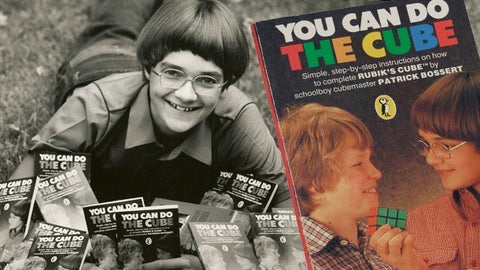
The first-ever guide was created by a 13-year-old
In the initial days of Rubik's Cube release, a 13-year-old boy, Patrick Bossert, had published a book called 'You Can Do the Cube' in 1981. This guide sold over 1.5 million copies. In fact, it had become a universal seller and is it still available for purchase!
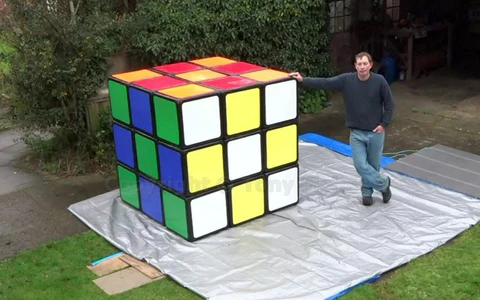
The Largest Cube
The largest Rubik's Cube in the world is 2.022m (6 ft 7 inches) x 2.022m (6 ft 7 inches) x 2.022m (6 ft 7 inches). It was achieved by Tony Fisher on 18th November 2019. All the layers of the Cube move exactly like a Rubik's Cube. However, you might have to lift the whole Cube.